

Structural health testing and safety early warning system
overview
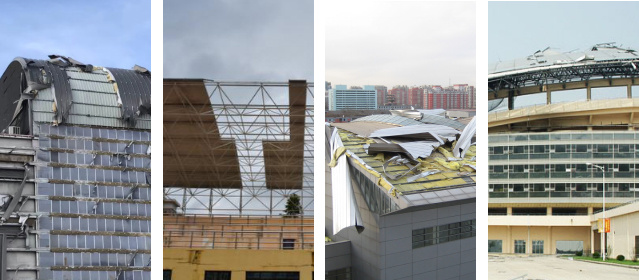
In recent years, with the rapid improvement of the domestic construction level, large-span spatial structures have been widely used in various large-scale stadiums, theaters, conference and exhibition centers, airport terminals and other important landmark buildings with dense population and large-scale event venues; However, due to its unique shape, complex system, high difficulty in construction technology, and a large number of new materials such as sheet metal and membrane materials as its outer protection system, under the coupling effect of complex external environment loads, material aging and other factors, it will be inevitable. In extreme cases, once a structural component is damaged, it will cause continuous damage to the enclosure system, which will lead to catastrophic emergencies and have a serious impact on the safety of life and property. Therefore, the structural health of the building metal envelope system is closely related to each of us, and will also become the focus of attention in various fields.
At present, in the monitoring of building enclosure systems, real-time alarms are still in a blank stage; and the online monitoring solution based on the wireless Internet of Things can effectively solve the difficulty of implementing large-span spatial structure monitoring equipment due to its advantages of light deployment, wireless interconnection, and cloud computing. , difficult monitoring and other issues, from the technical analysis point of view, it is more suitable for the monitoring of large-span spatial structure buildings.
solution
Aiming at the current health monitoring and operation needs of large public buildings, the Internet of Things system based on the cloud platform is adopted. Through the miniaturized wireless sensor system, the wireless communication means of the self-organizing network is used, and the powerful computing, storage and compatibility capabilities of the cloud platform are supported. Under this circumstance, the networked, intensive, real-time, simplified and easy-to-use management of building health monitoring will be realized.
System functions
1. The system uses general-purpose sensors, which can detect temperature, humidity, stress, wind pressure, wind speed, wind shock, water depth, etc.;
2. Using wireless transmission mode, maintenance-free within 5 years can be achieved;
3. The system does not need to install power and data lines, reducing construction links, and can be deployed in completed buildings;
4. Adopting a simple and easy-to-implement mode, the operation is simple and flexible, and it is suitable for the construction crowd to operate;
5. Remote real-time monitoring of the building envelope system;
system structure
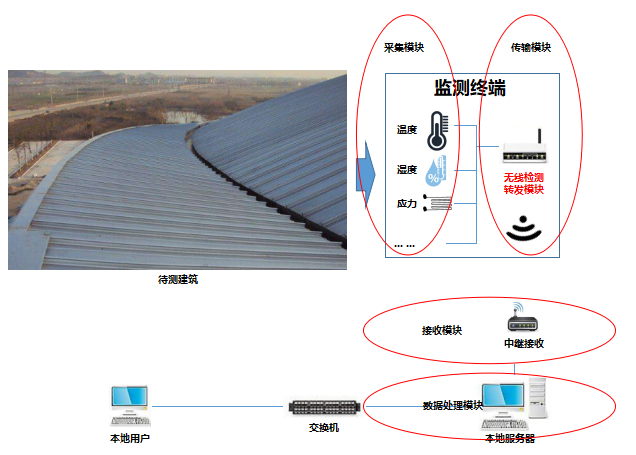
The wireless IoT monitoring system architecture is mainly divided into three layers:
(1) Monitoring network composed of various types of wireless sensor nodes
Various types of industrial-grade wireless smart sensors and distributed wireless collectors that can be connected to traditional types of sensors form the collection nodes of the wireless Internet of Things monitoring system.
(2) Data transmission network
The network can be flexibly set up through wireless, collect the data collected on site to the wireless receiver, and then upload the data to the online monitoring cloud platform through the wired network to realize real-time data transmission.
(3) Monitoring cloud platform system
The collected data is stored and monitored, and services such as data statistics, analysis, drawing, report summary, and automatic early warning are provided, and can be accessed and used through a computer browser or a mobile terminal.
System building blocks
1. Acquisition module: mainly responsible for the acquisition and sensing of temperature, humidity, stress and strain, water depth measurement, wind speed, wind pressure, etc.;
2. Transmission module: mainly responsible for wirelessly transmitting the data collected by the acquisition module to the background system according to the setting and receiving the action instructions issued by the background receiving module, and responding;
3. Receiving module: mainly responsible for receiving the data transmitted by the transmission module and issuing control instructions to the transmission module;
4. Data processing module: It mainly analyzes and counts the received data for administrators to manage and view;
system features
(1) Ensure that the "full life cycle" of the building metal enclosure system can completely obtain the information of each structure, and use two methods of periodic detection and continuous monitoring to process the information to improve efficiency and reduce costs.
(2) Based on the mining of data rules, make full use of the value of data, and timely grasp the abnormal state and safety state of the building metal enclosure system structure.
(3) Pay close attention to whether the load and response of the structure during operation are consistent with the design, and through analysis and research, improve the safety of the structural design in time to ensure the life of the structure.
(4) The cloud computing system based on the professional data analysis center provides cheaper data analysis and sharing services, and the characteristics of intelligent and intelligent systems will be more significant, making future smart cities possible.
Reference Standard
"Engineering Measurement Specifications" (GB50026-2007)
"Code for Measurement of Building Deformation" (JGJ8-2007)
"Global Positioning System (GPS) Measurement Specification" (GB/T 18314-2009)
"Unified Standard for Reliability Design of Building Structures" (GB50068-2001)
"Code for Building Structure Loads" (GB50009-2012)
"Code for Design of Steel Structures" (GB 50017-2003)
"Technical Specifications for Structural Monitoring of Public Buildings" (Draft for Comment)
"Technical Specifications for Structural Analysis and Monitoring in the Construction Process of Construction Engineering" (JGJ/T302-2013)
Copyright © 2023 Zhuhai Anweite Engineering Testing Co., Ltd

